

- She Was Hanging There
- The One Who Noticed
- She Had Given Up
- Untangling Her
- The Moment She Was Free
- What One Stop Changed
- The Ones We Do Not See
- Why It Matters
- Frequently Asked Questions
- How do deer get stuck in fences?
- What should I do if I find a deer stuck in a fence?
- Can a deer survive being trapped in a fence overnight?
- Why are highway fences dangerous for wildlife?
Hundreds of cars passed that stretch of highway every hour. Windows up. Music on. Eyes fixed on the road ahead. No one was looking at the fence.
Why would they? It was just a fence. Steel posts and wire mesh running along the shoulder for miles, separating the highway from the open fields beyond. The kind of thing you see a thousand times and never think about.
But that evening — just as the light was beginning to fade and the sky was turning that quiet shade between day and dark — something was wrong at the fence.
Something small. Something alive. Something that had stopped moving a long time ago.
She Was Hanging There
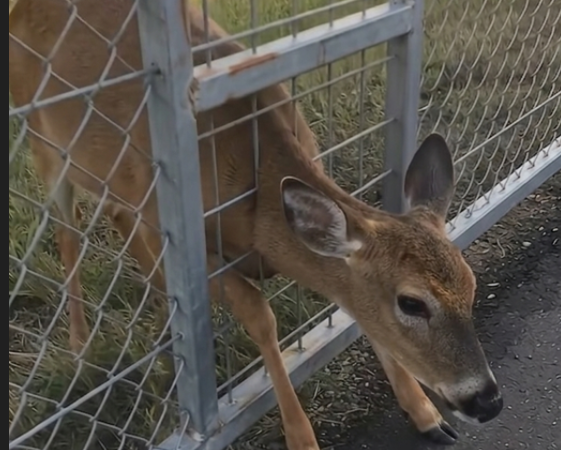
A young doe — barely past fawn age, still carrying the thin, delicate frame of an animal not yet fully grown — was caught in the wire. Her back legs were tangled in a section of mesh fencing about two feet off the ground. The wire had wrapped around both hind legs, twisted tight by her own desperate attempts to free herself.
She was not struggling anymore.
Her body hung at an awkward angle, her front hooves barely touching the dirt below. Her head drooped low. Her ears, usually tall and alert, lay flat against her neck. Her ribs moved slowly — shallow, tired breaths that barely lifted her sides.
Her eyes were open. Wide. Still. Watching the cars go by. Watching headlight after headlight sweep across the pavement and disappear. Dozens of them. Maybe hundreds. None of them stopped.
She had been there long enough for the ground beneath her front hooves to be scratched bare. Long enough for her body to stop fighting. Long enough for her breathing to slow to something that barely counted as breathing at all.
The One Who Noticed
Marcus was driving home from a twelve-hour shift. Tired. Hungry. Running on coffee and habit. The kind of drive where your body does the steering and your mind is somewhere else entirely.
He almost did not see her.
It was the reflection. A single flash of light — his headlights hitting the deer’s eye for a fraction of a second as he passed the fence at sixty miles an hour. Just a tiny flicker of something alive in a place where nothing alive should be.
He was two hundred yards past it before his brain caught up with his eyes.
He pulled onto the shoulder. Sat there for a moment. Told himself it was probably nothing. A bag caught in the fence. A piece of fabric. Something the wind had tangled up.
But he could not drive away.
He turned on his hazard lights, grabbed a flashlight from the glove box, and walked back along the shoulder toward the fence. The cars kept coming. Fast. Loud. Shaking the air around him every time one passed. No one slowed down. No one looked.
And then he saw her.
“I thought she was gone at first. She was so still. I pointed the light at her and she didn’t move, didn’t flinch. Then I saw her side move — just barely — and I realized she was still breathing. Barely. But still breathing.”
She Had Given Up
Marcus stood three feet away from her and she did not react. No panic. No kicking. No attempt to run or pull away. She just looked at him with those wide, dark, unblinking eyes.
That was the part that hurt the most.
A wild deer — an animal built entirely around fear and flight, an animal whose every instinct says run — was looking at a human standing right next to her and she did not move. Not because she was calm. Not because she trusted him.
Because she had nothing left.
Her legs had stopped bleeding, which meant the wire had been cutting into them long enough for the wounds to start drying. Her muscles had gone slack. Her body had used up everything it had — every burst of energy, every surge of adrenaline, every frantic kick — and now there was nothing. Just an animal hanging in a fence, breathing, waiting for whatever came next.
Marcus knelt down beside her. The ground was cold. The cars were still flying past behind him. The flashlight shook slightly in his hand.
He did not know what he was doing. He was not a vet. He was not a wildlife rescuer. He was a guy driving home from work who had seen a flash of light in the wrong place.
But he was here now. And she was still alive. And that was enough reason to try.
Untangling Her
The wire was bad. Worse than it looked from a distance. Two loops of thin mesh had wrapped around both hind legs just above the hooves, and her struggling had pulled them tighter with every kick. The wire had bitten into her skin in several places. Some sections had twisted so many times they had formed hard knots that his fingers could not grip.
He went back to his truck and found a pair of pliers in the toolbox behind the seat. Not the right tool. But the only tool he had.
He started on the first leg.
The moment he touched the wire, she flinched. A small, weak jolt through her body. Her head lifted an inch. Her nostrils flared. For a second, something came back into her eyes — that old, deep instinct telling her to run, to kick, to get away.
But she could not. And after a moment, the fight left her again. Her head dropped back down. Her body went still.
Marcus worked slowly. One strand at a time. Cutting where he could. Unwinding where he could not. Talking to her the entire time — not because he thought she understood, but because the sound of a calm voice was the only thing he could give her while his hands worked on the wire.
The first leg came free after ten minutes. It dropped limply to the ground. She did not move it.
The second leg took longer. The wire had wrapped higher and tighter, and some of it was buried beneath swollen skin. He had to stop twice to wipe his eyes. Not from the cold.
“I kept thinking — how long was she here? How many people drove past this fence today? How many saw something and kept going? I almost did the same thing. I almost kept driving.”
The Moment She Was Free
The last piece of wire came loose with a small snap. Her second leg dropped. For a moment — a long, silent, breathless moment — nothing happened.
She lay on the ground. Both legs free. Her body crumpled against the base of the fence like something that had been held up by strings and then released. She did not stand. She did not try. She just lay there, sides moving slowly, eyes half open, as if her body had not yet realized it was no longer trapped.
Marcus stepped back. Five feet. Then ten. He turned off the flashlight. He stood in the dark on the shoulder of a highway and waited.
One minute passed. Then two.
Her ear twitched. Just one. The left one. It lifted slightly, turned toward the sound of the wind moving through the grass on the other side of the fence. Then the other ear followed.
Her head came up. Slowly. Shakily. Like someone waking from a long, heavy sleep. She blinked. Once. Twice. Her nose moved — taking in the air, reading the world around her the way deer do, processing everything through scent before sight.
Then her front legs moved. She planted them beneath her chest and pushed. Her body swayed. She almost fell. But she caught herself. Her hind legs — the ones that had been wrapped in wire for hours, the ones that should not have worked at all — trembled and bent and then straightened.
She was standing.
She stood there for a few seconds, swaying slightly, testing her own weight. Then she turned her head and looked at Marcus. Not with fear. Not with panic. Just a long, quiet look from an animal who had been given something it had stopped hoping for.
Then she walked. One careful step at a time. Through the gap in the fence where the wire had been cut. Across the grass. Into the tree line at the edge of the field.
She paused once — right at the edge of the darkness — and turned her head back toward the highway. Toward the man standing on the shoulder. Toward the fence that had held her.
Then she disappeared into the trees.
What One Stop Changed
Marcus stood on the shoulder for a while after she was gone. Cars kept passing. Fast. Loud. Unaware. The world had not stopped for any of it — not for her suffering, not for her rescue, not for her quiet walk into the dark.
He walked back to the fence and spent another fifteen minutes removing the loose wire that had trapped her. He pulled it free, rolled it up, and threw it in the back of his truck so it would not catch another animal. Then he drove home.
He did not post about it that night. He did not tell anyone. It was not until the next morning, sitting at his kitchen table with a cup of coffee, that he told his wife what had happened. He could barely get through the story.
“It wasn’t the rescue that got to me. It was her eyes when I first found her. She had given up. She had completely given up. And I almost drove past her. That’s the part I can’t stop thinking about.”
The Ones We Do Not See
Every year, thousands of deer and other wildlife get caught in roadside fencing across the country. Most are never found. They struggle until they cannot struggle anymore, and the rest happens in silence, in places no one looks at, along stretches of road that everyone drives past without a second thought.
The fences are not built to trap them. They are built to protect them — to keep them off highways where they could be hit. But for animals that do not understand barriers, that do not know where the safe crossings are, that are driven by instinct to move through the same corridors their mothers and grandmothers used — the fences become something else entirely.
They become walls with no doors. And sometimes, for the unlucky ones, they become traps with no escape.
This deer was lucky. Not because the wire was loose or the injuries were minor. She was lucky because one person, out of hundreds who passed that fence that day, noticed a small flash of light and decided not to keep driving.
That is all it took. One person. One decision. A few minutes on the side of a dark road.
It was not dramatic. It was not heroic in the way movies make things look heroic. It was a tired man with a pair of pliers and a flashlight, kneeling in the dirt beside a scared animal, doing something small that felt like the only right thing to do.
And because of that, she walked into the trees that night instead of staying in the wire.
Because of that, she lived.
Why It Matters
We live fast. We drive fast. We scroll fast. We move through the world at a pace that makes it easy to miss things. Easy to look past the small, still, quiet things happening at the edges — at the fences, in the ditches, along the shoulders of roads we take every day.
But sometimes the most important thing you will ever do is not something big. It is something small. It is slowing down. It is looking twice. It is pulling over when every part of your tired body is telling you to keep going.
It is noticing.
Because for every animal found and freed, there are others still waiting in the wire. Still breathing. Still hoping — even after they have stopped hoping — that someone will see them.
Be the one who sees them.
If you find a wild animal trapped in fencing or debris near a road, do not attempt to free it without caution. Contact your local wildlife rescue service or animal control. Keep your hazard lights on, maintain a safe distance, and wait for professional assistance. Injured wildlife can react unpredictably when approached.
Frequently Asked Questions
How do deer get stuck in fences?
Deer often get tangled in wire fences when they attempt to jump over them and misjudge the height. Their hind legs or antlers can catch on barbed wire or mesh fencing, trapping them in painful and dangerous positions. Young deer and fawns are especially vulnerable because they lack the strength and experience to clear tall barriers.
What should I do if I find a deer stuck in a fence?
Do not approach the deer too quickly as it may panic and injure itself further. Call your local wildlife rescue service or animal control immediately. If the deer is near a road, turn on your hazard lights to alert other drivers. Stay at a safe distance and keep the area quiet until professional help arrives.
Can a deer survive being trapped in a fence overnight?
Survival depends on the severity of entanglement, weather conditions, and how long the animal has been trapped. Prolonged stress, dehydration, and restricted blood flow from tight wire can become life-threatening within hours. Early rescue significantly increases the chances of survival and full recovery.
Why are highway fences dangerous for wildlife?
Highway fences are designed to keep animals off roads but can become traps when animals attempt to cross them. Wire mesh, barbed wire, and narrow gaps can catch legs, hooves, and antlers. Wildlife-friendly fencing alternatives with smooth top rails and wider spacing are increasingly being adopted to reduce these incidents.






0 Comment