

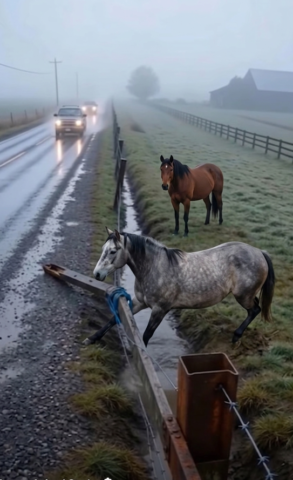
A devastating, life-or-death situation unfolded just inches from a busy highway early this morning, proving how quickly a routine day can turn into a absolute nightmare. A young dapple-gray foal slipped from the safety of its pasture, plunging into a deep, mud-slicked drainage trench. Completely wedged between the steep gravel road and a heavy wooden fence, the animal is currently pinned in place, unable to move forward or pull its fragile legs from the suctioning wet clay.
Every frantic attempt to escape only causes the foal to slide deeper into the freezing mud.
A Mother’s Heartbreaking Witness
Just feet away, a dark chestnut mare stands completely helpless on the safe side of the fence. Caught in a state of pure panic, she refuses to leave her baby’s side, leaning over the wires to offer low, anxious nickers as she watches her offspring fight for breath. The road conditions are treacherous, the fog is thickening, and cars are beginning to approach the area.
Local commuters have stopped, realizing that a solo rescue could cause catastrophic injuries. A specialized large-animal rescue team has just been dispatched with emergency rigging, but time is running out as hypothermia and exhaustion set in.
The Hidden Danger of the Autumn Thaw
To understand how this nightmare began, you have to look at the treacherous terrain of Route 9. Following days of unrelenting autumn drizzle, the clay-heavy soil bordering the local horse pastures had transformed into a deceptive, slick trap. The young foal, naturally curious and eager to explore the perimeter of the field, had ventured just a few inches too close to the property’s boundary line.
In a split second, the ground gave way. The foal’s hind hooves lost all purchase on the slick grass, sending the young animal sliding backward into the narrow, V-shaped drainage ditch that runs parallel to the asphalt highway.
Because the trench is designed to channel heavy rainfall away from the road, it is deep, narrow, and lined with thick, heavy muck. Within minutes of trying to scramble out, the foal’s heavy hindquarters became completely suctioned by the wet clay. The more the poor animal thrashed, the deeper it sank, until its chest was pinned entirely against the unforgiving wooden baseboards of the perimeter fence. It was a perfect, agonizing trap: no room to turn, no traction to climb, and no way out.
A Mother’s Love Put to the Ultimate Test
While the foal fought against the crushing weight of the mud, a secondary tragedy was playing out just three feet away. The foal’s mother, a gorgeous, high-spirited chestnut mare, refused to abandon her baby. Throughout the entire ordeal, her maternal instincts were on full display, showcasing an emotional bond that stunned the onlookers who eventually gathered at the scene.
The mare didn’t run for the hills, and she didn’t blindly pace the field. Instead, she stood like a sentinel of pure heartbreak right at the fence line. Her coat was slicked dark by the heavy, freezing fog, and her ears were pinned sharply forward, tracking every single breathless gasp her foal made.
Every few moments, the foal would let out a high-pitched, exhausted whinny—a cry for help that broke the hearts of everyone nearby. In response, the mare would lean her long neck over the top strand of the fence, risking injury to herself, just to touch her muzzle to the foal’s cold ears. She blew warm air onto the trembling baby, letting out low, rumbling, rhythmic vibrations from deep within her chest. It was the only comfort she could provide, a desperate attempt to tell her terrified baby that she wasn’t alone. Yet, despite her immense physical strength, she was entirely powerless to pull the foal from the earth.
The Commuter Who Refused to Drive By
The situation could have easily ended in a quiet catastrophe if not for Marcus, a local utility worker who happened to be driving his morning route at 5:30 AM. Driving through a thick, milk-white fog that reduced visibility to less than fifteen feet, Marcus was keeping his eyes locked onto the white road lines when his headlights caught a sudden, violent flash of movement in the ditch.
“At first glance, I honestly thought it was a piece of discarded machinery or a tarp that had blown off a truck,” Marcus said later, his voice still shaking from the memory. “But as my truck crept closer, the silhouette of a horse’s head emerged from the mud. I saw those eyes wide with pure terror, and my heart just dropped into my stomach.”
Marcus immediately pulled his heavy truck over, activating his bright amber hazard lights to create a makeshift physical barrier on the slick, narrow road. He knew that if a speeding semi-truck or an inattentive commuter came flying through the fog, the noise alone could cause the foal to snap its own spine in a panic, or worse, cause a multi-car pileup.
Stepping out into the biting morning air, Marcus approached the fence line. The foal was thrashing violently, its muscles bunching and straining so hard that veins were bulging along its neck. Marcus instantly recognized the danger: entering that narrow ditch alone to pull a 400-pound, panicked animal was a recipe for disaster. One misplaced kick from a horse fighting for its life could be fatal. Keeping his distance to avoid escalating the panic, Marcus pulled out his radio and made an emergency call directly to the county sheriff, demanding the immediate dispatch of the regional large-animal rescue team.
The Midnight Extraction Team Arrives
The next forty-five minutes were a grueling race against hypothermia. The temperature was dropping, the fog was thickening, and the foal’s frantic movements were beginning to slow down drastically—a clear sign that sheer exhaustion and the freezing mud were taking their toll. The animal’s head began to sag against the wooden fence post, its breathing growing painfully shallow.
Just as hope seemed to be fading, the distant, low rumble of a heavy-duty diesel engine pierced the quiet fog. The specialized animal rescue unit had arrived.
The team consisted of two veteran local ranchers, Caleb and Silas, who spent their lives handling heavy livestock in unpredictable terrain. They didn’t rush in with shouting and chaos; instead, they moved with a calculated, professional calm that immediately brought down the tension on the roadside. They looked at the angle of the ditch, the suction of the clay, and the highly protective stance of the mother mare.
“If we try to drag this baby out by the neck or the front legs, the resistance from that thick mud will dislocate a shoulder or break a bone instantly,” Caleb explained quietly to the small crowd of stopped commuters. “We have to lift it vertically, and we have to do it completely evenly.”
The Heart-Pounding Mechanical Lift
Working with absolute stealth, Silas crept along the edge of the ditch, using low, soothing vocal tones to keep the foal from throwing its head. With a long, blunt guide rod, the rescuers carefully fed two massive, heavy-duty canvas lifting straps directly under the foal’s mud-slicked belly.
The moment the coarse fabric touched its sensitive underside, the foal exploded into a final, desperate burst of thrashing, throwing gray muck all over the rescuers’ jackets. The chestnut mare erupted too, rearing back slightly and striking the ground with her hooves, her eyes wild as she watched men surround her baby.
“Steady! Stay calm, mama,” Silas called out, never breaking his slow, rhythmic movements. The team held their ground, waiting out the panic until the foal once again went still from sheer exhaustion.
With the straps successfully looped beneath the foal’s torso, Caleb locked the heavy steel carabiners onto a mechanical hoist extended from the rear crane arm of their rescue truck. The steel cables went taut with a loud, metallic clink.
“Alright, engage the winch,” Caleb ordered. “Slow and steady. Do not jerk the line.”
The hydraulic motor hummed to life, a low whine that filled the foggy air. The cables strained. For three agonizing seconds, nothing happened—the suction of the wet clay refused to let go of its prize. The foal let out a sharp, panicked cry as it felt its body being squeezed.
Then, with a loud, wet, releasing sound, the mud gave way.
A Triumphant Return to the Meadow
The mechanical hoist lifted the dapple-gray foal cleanly into the air, hoisting it straight up out of the dark trench. The rescuers carefully swung the crane arm over the top wire of the fence line, completely bypassing the barrier, and lowered the mud-covered animal gently onto the lush, solid pasture grass of the meadow.
The second the pressure left the canvas straps, a miracle happened. The foal didn’t lie there defeated; instead, fueled by a massive surge of pure adrenaline, it scrambled wildly with its front legs and popped right up onto all four hooves. Aside from being caked in cold, gray muck from nose to tail, the young animal was completely unbroken and uninjured.
The dark chestnut mare didn’t waste a single second. She charged across the grass, letting out a thunderous, triumphant snort that echoed across the entire valley. She threw her head over her foal, pushing her muzzle against its neck, checking every leg, and frantically licking the cold mud from its face. The foal leaned heavily into its mother’s side, finally safe, finally warm.
As Marcus, Caleb, and the small group of onlookers packed up their gear into the morning fog, they watched the two horses turn together and trot deep into the safety of the pasture. The roadside ditch was left completely empty, a stark reminder of a morning where community, quick thinking, and a mother’s fierce love won the day.





0 Comment