

We see it all the time along riverbanks, canals, and busy country roads: tangled bundles of clear fishing line, discarded plastic wrappers, and abandoned recreational gear. To a passing driver or an afternoon walker, it’s just an eyesore—a minor blemish on the landscape. But to the wildlife trying to survive in the narrow strips of nature alongside our concrete infrastructure, it is a hidden, lethal trap.
A devastating new photograph surfacing online captures this exact reality in its rawest, most unfiltered form. The agonizing story behind the lens is serving as a massive wake-up call for communities everywhere, proving that human carelessness has an immediate, heartbreaking face.
A Scene of Absolute Panic Along the Canal
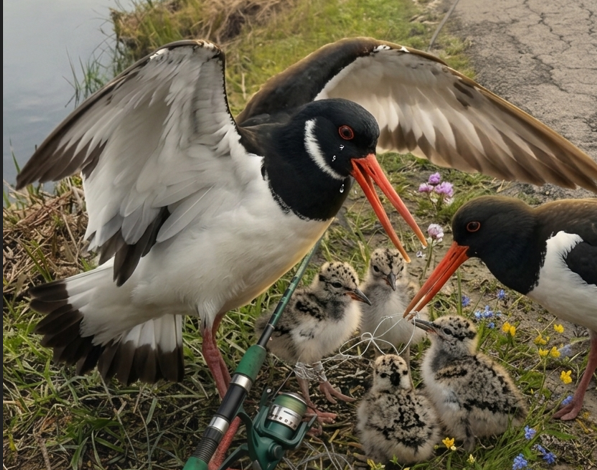
The image, captured along a quiet roadside canal, reveals a scene of utter panic and domestic heartbreak. A mother oystercatcher, instantly recognizable by her bold black-and-white plumage and striking, elongated orange beak, is hopelessly pinned to the muddy bank.
Beside her, a heavy, commercial fishing rod sits completely abandoned, its green handle half-buried in the dirt and weeds. Trailing from the plastic reel is a chaotic, bird-nest tangle of high-strength monofilament fishing line.
That nearly invisible nylon string has wrapped multiple times around the mother’s leg, pinning her securely to the ground. With her powerful wings flared wide in a desperate, thrashing bid for freedom, her beak is thrown open in a sharp, panicked cry for help. If you look closely at her face, tears track down her feathers as she faces a cruel truth: she is entirely trapped, exhausted, and her vulnerable family is in immediate danger.
A Father’s Desperate Attempt at a Rescue
What makes this specific scene resonate so deeply across social media isn’t just the mother’s isolated struggle—it’s the profoundly emotional response of her family.
Huddled in the grass directly beneath her massive, protective wings are her four tiny, speckled chicks. They are completely dependent on their parents, unable to forage for food or defend themselves, and visibly terrified by the distress of their mother. They can do nothing but watch.
The Hidden Crisis of “Ghost Gear”:
Lifespan: Modern monofilament fishing lines can take up to 600 years to naturally decompose in the wild.
The Threat: Because it is designed to be completely invisible underwater, birds and marine life never see the trap until they are already caught.
The Impact: Entanglement leads to severe lacerations, infection, exhaustion, and eventual starvation as animals exhaust themselves trying to break free.
Seeing his mate in agony, the father bird has rushed to the scene rather than fleeing to safety. In a display of profound animal intelligence, empathy, and devotion, he can be seen using his own long orange beak to pull frantically at the tangled knot of nylon line. He bites at the plastic threads, trying desperately to snap the bounds holding her down. He isn’t just trying to clear debris; he is actively fighting to save the mother of his chicks before it is too late.
Why Roadside Waterways Are Becoming Death Traps
This specific family did nothing wrong. They were simply attempting to navigate a habitat that is increasingly crowded, fragmented, and altered by human activity. Waterways that run parallel to roads are prime hunting and nesting grounds for coastal and river birds, but they are also the exact places where human litter accumulates the fastest.
When a fishing line is snapped or carelessly left behind, it doesn’t just sit there. Wind, water currents, and passing vehicles push it into the thick reeds where ground-nesting birds seek shelter.
Without human intervention, a trapped mother bird faces a grim, painful fate. She cannot look for food to sustain her high metabolism, she cannot protect her babies from the predators driving by or lurking in the brush, and her own frantic thrashing only serves to tighten the deadly nylon loops around her circulation.
Turning Internet Heartbreak Into Real-World Action
Fortunately, this story has a silver lining. The image spread so rapidly across local networks that it alerted wildlife rescuers in the area. Teams arrived on the scene just in time to safely secure the birds, carefully cut the monofilament line away with surgical scissors, treat the deep cuts on the mother’s leg, and ensure the family remained safely together.
But for every photo that goes viral, thousands of innocent animals suffer this exact same fate in complete silence. We have a collective responsibility to ensure our hobbies do not become a death sentence for the local ecosystem.
How You Can Protect Wild Families Today:
-
Account for Your Gear: If you fish, make it a strict rule to account for every single inch of your line, hooks, and plastic packaging. If your line snaps, take the extra ten minutes to retrieve it from the brush.
-
Carry a Pocket Cutter: Always keep a small pair of shears or a multi-tool with you when exploring nature so you can safely dismantle any “ghost gear” you stumble across.
-
Clean Up Near Public Waterways: If you see discarded fishing line, plastic rings, or trash near a canal or river bank, take two minutes to pick it up and dispose of it in a secure, closed bin.
-
Educate and Share: Use your voice and your social media presence to remind others that our trash doesn’t just disappear when we leave—it has real, breathing, and painful consequences for the families sharing our world.
Let’s ensure that no more wild families have to face this terrifying, human-made battle alone.




0 Comment