

We often look for heartbreak in loud places. We look for it in the frantic, desperate barking that echoes off concrete walls, the pacing back and forth along chain-link barriers, or the heavy rattling of metal kennel doors. But anyone who has spent time inside an animal shelter knows that the deepest, most profound sorrow is completely silent.
It doesn’t ask for attention. It doesn’t demand to be seen.
Instead, it pulls inward. It is the story of a mother dog who has given everything she ever had to the world, now curled into a tight corner, trying to become smaller than her own sadness.
The Ache of Empty Space
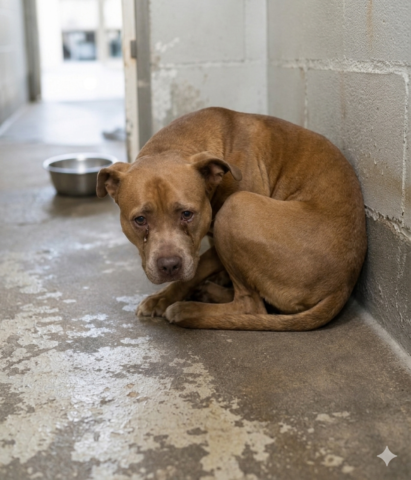
She curled herself into the corner like she was trying to hide the part of her that still hurt.
The kennel floor was wet and cold beneath her paws, marked with pale patches where water had dried unevenly across the concrete after the morning wash. The wall beside her was rough gray block, scratched and worn at the lower edge—the kind of wall that does not soften anything it touches. Down the hallway, a metal bowl sat out of focus, catching a small circle of light she did not look toward.
She had chosen the narrowest place.
Her body folded tightly against the wall, back curved, legs tucked under her,
tail pulled close as if she were trying to disappear entirely.
She did not lie down fully, exposing her belly to the world. Nor did she sit upright with confidence, waiting for a treat or a friendly hand. She stayed somewhere in between—crouched, guarded, held together entirely by habit. Her face was turned toward the open space of the hallway, but her body stayed rigidly pressed to the corner.
That was the whole ache of her: wanting to look, but deeply afraid to hope.
Two dark tracks ran beneath her eyes, shining like ink against her brown face. They looked almost too heavy for such a quiet moment. She was not making a single sound. She was not whining, not asking, not pushing herself forward to the bars. Yet her eyes spoke the words she was far too tired to give.
A Body That Remembers
Her eyes were soft, but they were not peaceful. They carried the unmistakable look of a mother who had searched for a sound that never came.
The tiny, clumsy paws. The small, high-pitched cries. The warm, moving bodies that once crowded near her belly, relying on her for everything. Now, the shelter kennel held only hollow echoes, and every sharp sound down the corridor seemed to remind her that something familiar, something precious, was missing.
Her body still held the physical map of her past:
-
The softness of her belly, bearing the marks of life she had brought into the world.
-
The tired heaviness in her shape, showing the physical toll of giving away her own strength to keep others alive.
-
The protective curve of her spine, a posture built from the lifelong habit of keeping small things safe.
It wasn’t the cold wall, the wet floor, or the food bowl far behind her that told her story—it was the empty curve of her own body. It was a space where little lives may once have pressed close, where warmth may once have gathered, where she may have lowered her head again and again in the dark to check that everyone was still breathing. Now, she held only herself, folded into the corner like a question no one had answered.
The Long Work of Surviving
Before she ever arrived at this kennel, she had known the long, exhausting work of surviving. Her appearance suggested a life shaped by more than one season of deep hardship. Maybe she had carried litters in the brush, under porches, or in the corners of abandoned yards. Maybe she had given everything she had, season after season, until nurturing became less like a choice and more like the only language her body knew how to speak.
She likely knew the reality of hard streets and dim spaces—places where rest was never deep because something always needed watching. She had learned to eat quickly when food appeared, sleep lightly with her ears twitching at every shadow, and rise even when her bones ached and her body begged her to stay down.
A mother animal does not get to be tired the same way others do. She keeps listening. Keeps checking. Keeps giving warmth even when she has absolutely none left for herself.
Then came the shelter. To the human world, it was a rescue. A roof overhead, a steady bowl of food, a place away from the dangers of the outside world.
But safety does not automatically erase confusion. To her, the familiar smells were gone. The tiny bodies were gone. The world had shifted on its axis yet again, and no one could explain it to her in words she could understand. So she curled into the corner. Not because she had stopped feeling, but because she felt entirely too much.
The Turning Point
Still, her spirit had not hardened into anger. That was the strange, tender truth about her. Even with the marks of sorrow on her face, even with her body folded around a devastating absence, there was a lingering warmth left deep in her eyes. A soft willingness. A fragile, quiet wish to be seen as more than just what had happened to her.
She wasn’t just a tired body. She wasn’t just a mother without her puppies, or another number waiting behind a concrete wall. She was a heart that had given away all its love, quietly asking whether kindness could finally turn around and find her.
And then, the heavy metal door at the end of the isolation hallway opened.
Unlike the hurried, echoing footsteps of the morning cleaning shift, these steps were slow, deliberate, and quiet. They moved past the first few kennels and stopped right outside of hers.
A volunteer knelt down on the cold concrete. They didn’t stand tall over her, looming like a threat. They didn’t reach their hands aggressively through the bars to force her to move. Instead, they simply sat down on her level, leaning against the opposite wall, choosing to sit with her in the quiet space of her grief.
For the first time in days, the mother dog lifted her chin.
Her ears gave a tiny, tentative twitch forward. The person on the other side of the bars didn’t see a “broken” shelter statistic; they saw her. They began to talk to her in a soft, low, rumbling tone—acknowledging her pain, but speaking to the profound dignity of a survivor.
Slowly, almost imperceptibly, the tightly wound coil of her body began to loosen. Her back relaxed against the gray block. Her tail gave a single, hesitant thump against the damp floor. It was a tiny, fragile movement—but it was a bridge across a vast ocean of sadness.
Where Her Journey Continues
The rest of her beautiful journey is waiting for you below. Read the full, heartwarming story of her rescue, her very first night sleeping on a soft bed in a real home, and the incredible physical and emotional transformation that happened when someone finally chose to see the mother, and not just the sadness.
Read another heartbreak story: Dog Found Trapped Under Mud Protecting Her Puppies
How You Can Make a Difference
If this story touched your heart, please take a moment to Share it on Facebook, Instagram, or Twitter. There are thousands of forgotten shelter mothers sitting in corners right now, waiting for their second chance at life. You can help them by:
-
Sharing this post to raise awareness for shelter animals.






0 Comment