

- Wedged In With No Way Out
- She Had Not Left
- The Calf Was Getting Weaker
- Getting Help
- The Moment That Changed Everything
- She Was There The Whole Time
- A Bond That Needs No Words
- Frequently Asked Questions
- How do calves get trapped in ditches?
- What should you do if you find a calf stuck in a ditch?
- Do mother cows stay with their trapped calves?
- Can a trapped calf survive overnight?
The fog that morning was so thick you could barely see twenty feet ahead. The kind of morning where the world feels muted — where sound travels differently and everything moves a little slower than it should.
A truck was crawling down a narrow country road somewhere in the rural countryside, headlights cutting through the gray air. The driver almost did not stop. There was no reason to. It was just another stretch of fenced pasture, wet grass, and silence.
But something caught his eye near the edge of the road.
A shape. Small. Pressed low against the ground between the metal fence and the gravel shoulder. At first he thought it was a dog. Maybe a bag of feed that had fallen off someone’s trailer. He slowed down, leaned forward, and looked again.
It was a calf.
Wedged In With No Way Out
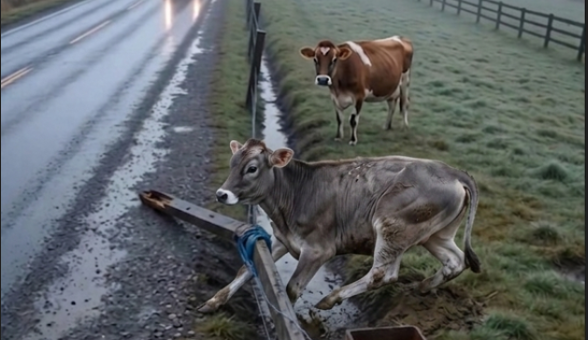
The young calf — gray-brown, barely a few weeks old — had somehow slipped into the narrow drainage ditch that ran between the fence line and the road. The ditch was just wide enough for its small body to fall in, but too narrow and too deep for it to climb back out.
Its front legs were bent awkwardly beneath it. Its hooves scraped against the wet concrete and mud at the bottom, searching for grip but finding none. Every time it tried to push itself up, its legs would slide and its body would drop back down into the same position.
It had been trying for a while. You could tell. The mud around the edges of the ditch was scraped and disturbed. The calf’s coat was soaked through — not just from the rain, but from the shallow water sitting at the bottom of the channel. Its breathing was fast. Its small body trembled.
But it was not the calf that made the driver pull over completely and turn off his engine.
It was the other cow.
She Had Not Left
Standing just a few feet away on the other side of the fence, on the wet grass of the pasture, was a brown and white cow. The mother.
She was not grazing. She was not looking at the road or the truck or the man stepping out of it. Her entire focus — every part of her attention — was fixed on the calf in the ditch.
She stood perfectly still. Her head was low. Her eyes were wide and locked on her baby. Every few seconds, she would shift her weight from one leg to the other — a slow, anxious rocking that anyone who has ever watched a worried parent would recognize instantly.
She had been standing there long enough for the grass beneath her hooves to be pressed flat into the mud.
“She wasn’t going anywhere. You could see it. That cow had decided she was staying right there until someone helped her baby. She would have stood there all day. All night. However long it took.”
The fence stood between them. Steel posts. Barbed wire. A barrier she could not cross. She could see her calf. She could hear it. She was close enough to lower her head and almost touch it. But she could not reach it. She could not pull it out. She could not do the one thing every part of her body was telling her to do.
All she could do was stay.
And so she stayed.
The Calf Was Getting Weaker
The driver, a local farmer named Thomas, recognized the situation immediately. He had seen calves get stuck before — in ditches, in fences, in mud — but this one was in a difficult spot. The ditch was narrow, the edges were slippery, and the calf had already exhausted most of its energy trying to escape on its own.
He knelt beside the ditch and looked down. The calf stared back at him. Its eyes were wide. Its nostrils flared with each quick breath. It let out a short, weak sound — not quite a cry, not quite a call. Something in between. Something that said: I have been here too long.
Behind the fence, the mother took a step forward. Then another. Her head dropped even lower. She let out a long, deep sound from her chest. A low, rolling call that vibrated through the foggy air.
Thomas had heard cows call before. This was different. This was not a regular sound. This was a mother talking to her child. Telling it she was still there. Telling it to hold on.
Getting Help
Thomas knew he could not do this alone. The calf needed to be lifted carefully — one wrong move and a leg could break, or the animal could panic and injure itself further. He called a neighbor. Then another. Within twenty minutes, two more trucks were parked on the shoulder of that quiet road, headlights glowing in the fog.
Three men stood around a ditch on a cold, gray morning, figuring out how to save a calf that weighed less than some of their dogs.
The mother watched every second of it.
One of the men brought a thick blanket from his truck. The plan was simple: slide the blanket beneath the calf’s body, support its legs, and lift it straight up and over the fence back into the pasture. No ropes. No machinery. Just hands and care.
The hardest part was keeping the calf calm. It had been struggling for so long that every touch made it flinch. Its legs kicked weakly. Its head swung side to side. But Thomas placed one hand on its neck and held it there, steady and warm, until the trembling slowed.
Then they lifted.
The Moment That Changed Everything
It took all three of them. One supporting the hind legs. One cradling the midsection with the blanket. Thomas guiding the front legs and head as they raised the calf up and over the metal fence.
The calf’s legs dangled for a moment. It let out one more sound — louder this time, sharper — and then its hooves touched grass.
It stumbled. Its legs buckled once. Twice. It stood there on shaking knees, soaked and muddy and exhausted, on solid ground for the first time in hours.
And then the mother moved.
She crossed the distance between them in three steps. Not running. Not charging. Just walking — steady and deliberate — straight to her calf. She lowered her massive head and pressed her nose against the calf’s face. She breathed on it. She nudged it gently with the side of her jaw. She ran her nose along its back, its legs, its belly — checking every part of it.
The calf leaned into her. Its whole body pressed against her front leg, and for a moment it just stood there, not moving, not making a sound. Just leaning.
“That calf just leaned into her and closed its eyes. Like it was saying — I knew you would not leave. And she didn’t. She never did.”
Thomas stood on the other side of the fence, muddy blanket in his hands, and watched. No one said anything for a while. There was nothing to say. They had all just witnessed something that did not need words.
She Was There The Whole Time
What stayed with the men that morning was not the rescue itself. It was not the cold or the fog or the difficulty of lifting a calf from a concrete ditch.
It was the mother.
She had no way to help. No way to reach her baby. No way to break through the fence or climb into the ditch or do any of the things she desperately wanted to do. She was powerless in every physical sense of the word.
But she did not leave.
She did not wander to the other side of the field. She did not go back to grazing. She did not give up and walk away when the hours passed and nothing changed.
She stood there. In the cold. In the fog. On mud that had swallowed her hooves. She stood and she watched and she waited and she called out to her baby over and over again — because that was all she could do.
And that was enough.
A Bond That Needs No Words
People sometimes underestimate what animals feel. They see a cow in a field and think it is just standing there. Just existing. Just another part of the landscape.
But anyone who was on that road that morning knows differently.
They saw a mother who refused to leave her child. They saw fear and patience and devotion in an animal that most people never look at twice. They saw something that runs deeper than instinct — something that looks and feels and acts exactly like love.
The calf made a full recovery. Within an hour it was nursing. By the afternoon it was walking alongside its mother through the pasture as if nothing had happened. The ditch was later covered with a metal grate to prevent it from happening again.
But for the three men who stood on that foggy road and watched a mother reunite with her baby, the morning was not something they would forget.
Some moments just stay with you. Not because they are dramatic or loud or extraordinary. But because they are quiet. And real. And they remind you of something you already knew but needed to see again.
Love does not give up. Even when it cannot do anything else — it stays.
If you find a trapped or injured animal on a roadside, do not attempt to free it alone. Contact your local animal rescue service, a nearby farmer, or emergency veterinary assistance. Keep yourself and the animal safe until help arrives.
Frequently Asked Questions
How do calves get trapped in ditches?
Young calves often fall into drainage ditches along rural roads when they wander too close to fence edges. Wet and slippery conditions after rain make the ground unstable, and their small bodies can slide into narrow gaps that adult cows cannot reach.
What should you do if you find a calf stuck in a ditch?
Do not attempt to pull the calf out by force as this can cause serious injury. Contact your local animal rescue service, a nearby farmer, or veterinary emergency line. Keep the area calm, stay at a safe distance from the mother cow, and wait for experienced help to arrive.
Do mother cows stay with their trapped calves?
Yes. Mother cows have an extremely strong maternal bond and will almost always stay near their distressed calf. They often become agitated and vocal, pacing and calling out, and will not leave the area even if they cannot physically help their young.
Can a trapped calf survive overnight?
It depends on the conditions. Cold weather, standing water, and exhaustion can be life-threatening for a young calf within hours. The sooner a trapped calf is found and freed, the better its chances of a full recovery.






0 Comment