

Every spring and summer, our local lakes and waterways transform into vibrant, bustling nurseries. Among the most iconic sights of the season is the mallard family—a mother duck proudly leading a perfectly orchestrated line of fluffy, bobbing ducklings across the water. It is an image of pure, tranquil nature.
But as our natural landscapes are increasingly swallowed by asphalt, concrete, and urban development, these picturesque moments can turn into sudden, desperate nightmares in the blink of an eye.
A gripping, high-stakes family emergency recently unfolded along a popular lakeside walking path. Captured on video by a stunned passerby, the footage reveals a heartbreaking scene that looked completely hopeless—until a stranger decided that doing nothing was not an option. This is the story of that emotional rescue, the terrifying flaw in our modern architecture, and the invisible battles our wild neighbors face every single day.
Part 1: The Panic on the Asphalt
The morning started out like any other for a local runner enjoying the cool, misty air along the lake’s edge. The water was as smooth as glass, reflecting the clear blue sky. But the peace was abruptly shattered by a sound that instantly signaled pure terror: the sharp, piercing, breathless quacks of a frantic mallard hen.
Following the sound, the runner came across a sight that would make anyone’s heart drop.
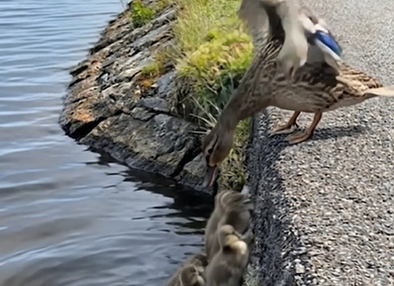
A mother duck was pacing erratically back and forth along the very edge of the asphalt road. Her body language radiated absolute panic. She wasn’t just calling out; she was screaming in the only way she knew how. She leaned precariously over a sharp stone lip, her wings flapping wildly, her neck stretched down to its absolute physical limit, trying to reach into the abyss below.
When you look over the edge, the tragedy becomes immediately clear.
Below her, trapped in the water against a sheer, vertical stone embankment, was her entire brood of newly hatched ducklings. They were caught in an exhausting, heartbreaking loop. Driven by the absolute primal instinct to stay with their mother, the tiny, fragile birds pushed their bodies against the slick stone wall, splashing vigorously, kicking their little legs, but remaining trapped in the exact same spot.
Because webbed feet are perfectly evolved for paddling but utterly useless for climbing vertical rock, the ducklings were trapped in a prison they couldn’t see, directly beneath the mother who would die to save them but couldn’t reach them.
Part 2: The Exhausting Fight Against Time
For several agonizing minutes, the scene played out like a slow-motion tragedy. The mother duck refused to leave her babies, desperately running down the road, looking for a slope, and then rushing back to lean over the edge again, almost falling in herself.
Down below, the situation was rapidly turning critical.
What many people don’t realize about newborn waterfowl is that they burn through their energy reserves at an alarming rate. In an untouched, natural ecosystem, shorelines feature gradual, muddy slopes with thick grass. If a family needs to leave the water, the ducklings simply waddle onto dry land.
But this reinforced, man-made urban wall offered zero traction. There was no ramp, no debris, no foothold. To make matters worse, waves bouncing off the hard stone wall created a turbulent backwash, forcing the tiny, two-inch-tall birds to swim twice as hard just to stay afloat.
Worse still, young ducklings do not yet possess waterproof feathers. They rely on their mother’s preen oil, rubbed onto them during brooding, to stay dry. Extended time trapped in deep, turbulent water causes them to quickly become waterlogged, leading rapidly to physical exhaustion, hypothermia, or making them easy targets for underwater predators.
The ducklings were visibly slowing down, their tiny heads dipping below the surface. The mother’s cries grew louder, a universal, maternal plea for help that no human could ignore.
Part 3: A Stranger Steps Into the Gap
Realizing that nature had been completely defeated by concrete, a kind stranger who had stopped to watch knew that if they didn’t act immediately, the entire brood would drown from pure exhaustion.
The stranger approached the edge slowly, dropping to their knees on the rough asphalt to avoid startling the mother into flying away completely. The mother duck fluttered back a few feet, her chest heaving, watching with intense, defensive anxiety—but she refused to abandon the area. She stood her ground, begging the human in her own way to do something.
Leaning dangerously far over the sharp stone lip, the rescuer reached down into the cool water.
The first scoop was a chaotic scramble of slippery, wet downy feathers. The rescuer gently cupped a tiny, shivering duckling and lifted it over the insurmountable concrete edge, placing it safely onto the grass. The moment its feet hit the solid ground, it let out a high-pitched peep, and the mother duck locked her eyes on it.
One by one, the rescuer reached down, scooping up two, three, four of the tiny birds. The process was tense; one slip could have sent the ducklings scattering into deeper water out of reach, or injured their incredibly fragile bodies.
Finally, the rescuer reached down for the last, weakest duckling, which was barely keeping its beak above the water, and lifted it to safety.
The moment the final duckling was placed on the grass, the frantic, panicked quacking instantly stopped. The mother duck rushed forward, fiercely gathering her shaken, wet brood underneath her wings to comfort them. After a quick headcount and a moment to catch their breath, she led her perfectly intact family away from the treacherous asphalt edge and deep into the safety of the nearby thick brush.
Part 4: Why Our Cities Must Change
This dramatic lakeside rescue ended in a celebration, but it shines a bright, urgent light on a massive, mostly invisible challenge facing urban wildlife across the globe.
While concrete pathways, seawalls, and jagged rock riprap look clean to the human eye and successfully prevent soil erosion for our roads, they rarely account for basic animal biology. A six-inch vertical barrier is nothing to a human step, but to a newborn animal, it is an impossible, fatal mountain.
What Should You Do If You Witness a Waterfowl Emergency?
If you find yourself in a similar situation, wildlife rehabilitators recommend a specific, careful protocol to ensure both you and the animals stay safe:
-
Keep the Crowds Back: If a crowd of well-meaning onlookers gathers to take photos, the intense stress can cause the mother duck to panic and fly away permanently, abandoning her brood to save herself. Keep the area quiet.
-
Look for the Passive Option First: Before grabbing the animals, look around for a long branch, a wooden plank, or even a thick piece of fabric or burlap. Draping this over the edge to create a temporary, shallow ramp (under 45 degrees) allows the ducklings to climb out on their own under their mother’s guidance, minimizing stress.
-
The Box Method: If you must manually scoop them out, place them immediately into a deep, open-top container or box so they don’t instantly hop back into the water. Once all are caught, move the box to a safe, grassy area nearby, tip it on its side, and back away so the family can reunite naturally.
Building a Better Future
While this lucky family had a human hero to pull them from the brink, local conservationists use powerful stories like this to push for systemic changes in urban planning.
Progressive cities are now implementing “wildlife escape routes” into their civil designs. This includes building integrated, textured wildlife ramps along concrete canals, using eco-friendly geotextiles instead of solid concrete walls, and leaving dedicated zones of natural, sloped wetlands within public parks.
Until those structural changes become the standard everywhere, it is entirely up to alert, compassionate community members to keep an eye on our wild neighbors—and ensure that a simple morning swim doesn’t become a tragedy.




0 Comment